Trailer sway has a handful of causes: tongue weight, speed, wind, tires and the hitch. They leave different fingerprints. A light tongue sways from the first mile, a shifted load sways on the way home, and wind sways when trucks pass and then settles. Find your row, take the reading, and the fix follows. The table prints as a card for the glovebox.
Trailer sway: which cause, and what to do
rvingtoolbox.com/guides/trailer-sway-causes
Why does my trailer sway? Start with when it happens
| When it sways | Most likely cause | The reading that confirms it | The fix |
|---|---|---|---|
| From the first highway mile, every trip, worse as you speed up | Tongue weight light: under 10% of the loaded trailer | Measure the tongue loaded, as you tow; divide by the loaded trailer weight | Move weight forward of the axles until it’s 10%–15% · Tongue weight → |
| Fine on the way there, sways on the way home | The load moved behind the axles: fresh tank drained, gray and black full, gear on the bumper | Where the tanks sit relative to the axles; measure the tongue again as loaded now | Dump before you leave, carry water forward, move bumper cargo into the truck · RV loaded weight → |
| Only when a semi passes or a gust hits, and it settles in two or three swings | Side force on a tall, flat-sided box; sway control missing or slack | Does it die out on its own? If it keeps going, it’s a loading problem, not wind | Slow down, move right, keep sway control tensioned; don’t tow in 20–25 mph crosswinds · Weight distribution hitch → |
| Above one speed, the same speed every time | You’re at the rig’s critical speed, and a light tongue lowers it | Note the speed it starts; check the tongue percent | Stay well under that speed; ST tires are rated 65 mph unless the sidewall says otherwise · Tongue weight → |
| Truck feels floaty, steering light, nose up, rear squatting | Front axle unloaded: no weight-distribution hitch, bars too light, or not tensioned | Front fender height unhitched, hitched, and hitched with the bars on | Set the bars to restore 50%–100% of the front axle’s load · Weight distribution hitch → |
| The rig squirms, wanders or darts over bumps rather than swinging | Tires: soft truck sidewalls, low rear psi, or a low or failing trailer tire | Cold psi on all tires against the door placard and the trailer’s weight label; look for uneven wear | Inflate to the placard cold; replace trailer tires older than about six years |
| Downhill, or when you brake and the trailer pushes | Trailer brakes doing too little: gain set low, or brakes out of adjustment | On a quiet road at 25 mph, the manual lever alone should nearly lock the trailer wheels | Raise the controller gain; downshift and take the hill slower · Brake controller → |
| Always nervous, even loaded right | Trailer too big for the truck: over 50% of its weight on a short wheelbase | Loaded trailer ÷ truck curb weight; the four towing checks | A heavier truck, a lighter trailer, or a hitch that controls sway with geometry · Can my truck tow this? → |
Tongue band 10%–15% of the loaded weight for a travel trailer (fifth wheels 15%–25%). Stickers, data plates and the tire sidewall are the limits.
- Off the gas. Let the rig slow on its own; don't brake the truck.
- Hold the wheel straight. Small corrections only; steering into the swing feeds it.
- Squeeze the trailer brake lever on the controller, gently. Braking only the trailer pulls it back into line behind you.
- Slow to well under the speed it started, then pull over and find your row above before going on.
Why does a light tongue make a trailer sway?
A trailer's own tires are what straighten it. Push the back of the trailer sideways and the tires resist; if the trailer's weight sits well forward of them, that resistance swings the trailer back into line and the swing dies out. Move the weight back toward the axles and the same nudge overshoots, swings back and overshoots again. Above a certain speed each swing is bigger than the last. That speed is the one that matters, and tongue weight sets it.
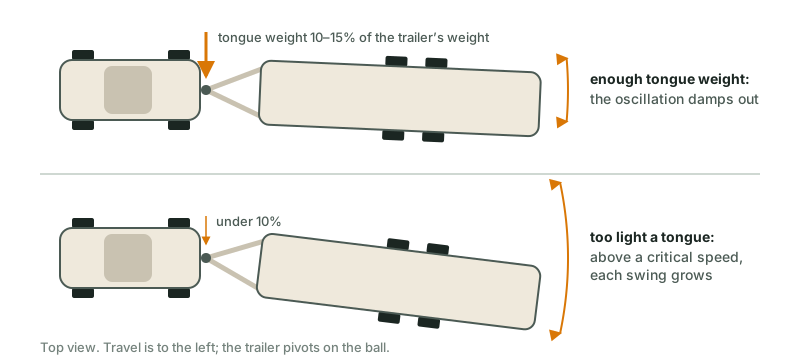
A University of Bath study (Darling, Tilley and Gao, 2009) ran 600 tests with a Ford Mondeo estate towing a purpose-built, fully adjustable trailer, set up to match a typical British touring trailer: 877 kg with a 52.4 kg nose mass, 5.97% of its weight. The car held a straight line at 30 to 60 mph, the driver started a swing with a steering input, and from how fast each swing died away the authors estimated the speed at which it would stop dying away at all. Less nose weight lowered that speed: "a nose mass of less than 2 per cent of the overall trailer mass has a zero damping speed below 60 mile/h." The gain from more nose weight flattened above 6%–7%, and the authors recommend "around 6–8 per cent". Yaw inertia (weight far from the trailer's middle), nose weight and the axle position were the dominant factors; by the abstract's account, "the trailer mass alone does not dramatically affect the high-speed stability". A longer hitch-to-axle distance helped, and higher tire pressure helped a little.
The 6%–8% figure is for European touring trailers. The US convention for travel trailers is 10%–15%, which sits above where the Bath curve flattens, and the margin covers a loaded rear bumper, water that moves during a trip, and a tongue nobody has weighed.
That's why the band's low edge is the one to respect. A tongue at 16% makes a truck squat and steer light, which is uncomfortable; a tongue at 8% makes the trailer the thing that decides where you go. The tongue-weight calculator measures it with a bathroom scale and a board, and shows how far moving cargo shifts it.
Why did it tow fine on the way there and sway on the way home?
Because the trailer you drove home isn't the one you weighed. On most travel trailers the fresh tank sits near or ahead of the axles and the gray and black tanks sit behind them, under a rear bathroom. A week of camping moves every gallon of water from one to the others, backward, and then the firewood and bikes go on the bumper. Here is a 30 ft trailer, 7,000 lb with an 840 lb tongue when it left home, axles 21 ft behind the coupler:
| Trip stage | Trailer | Tongue | Tongue % |
|---|---|---|---|
| Leaving home, weighed: fresh tank full | 7,000 lb | 840 lb | 12.0% in band |
| Fresh tank drained (45 gal used) | 6,625 lb | 769 lb | 11.6% in band |
| …into the gray tank (30 gal) | 6,875 lb | 697 lb | 10.1% in band |
| …and the black tank (15 gal) | 7,000 lb | 649 lb | 9.3% light |
| Firewood and bikes on the bumper (120 lb) | 7,120 lb | 598 lb | 8.4% light |
| At the dump station: gray and black dumped, bumper load into the truck | 6,625 lb | 769 lb | 11.6% in band |
Each row applies one change to the row above: tongue change = weight × its distance ahead of (+) or behind (−) the axles ÷ 21 ft. Fresh tank centered 4 ft ahead of the axles, gray 6 ft and black 8 ft behind, bumper 9 ft behind; water 8.34 lb/gal. Look under your own trailer: tank positions vary by floor plan.
The trailer ends the week at 8.4%, below the band without anything having gone wrong. The fix at the dump station costs nothing: dump both tanks and move the bumper load into the truck bed, and it's back to 11.6%. If you're heading to the next campsite rather than home, carry the water you'll need in the fresh tank, which sits forward, and dump the rest.
Once the 45 gallons have moved from the fresh tank to the gray and black tanks, the trailer weighs exactly what it did leaving home, 7,000 lb, and its tongue has dropped from 840 lb to 649 lb, 12.0% to 9.3%. A CAT scale ticket from the start of the trip would show a trailer "within its ratings" on the day it swayed. Weight behind the axles also counts twice: it takes load off the tongue and adds to the trailer weight the percentage is taken of.
Why does my trailer sway when a semi passes?
A truck passing at speed pushes a wall of air ahead of it and drags a low-pressure pocket behind: your trailer gets shoved away, then pulled in, in about a second. A travel trailer is a tall, flat sail, so the side force is large and it lands at the back, where it has the most leverage. A well-loaded trailer twitches and settles in two or three swings. One that keeps swinging after the truck has gone is telling you the trailer was already near its limit; the truck only started it. Crosswinds do the same thing without the truck, and the common advice is to park once gusts reach 20–25 mph. Sway control (a friction bar, or the friction or cam built into a weight-distribution head) adds damping against exactly this, and the weight-distribution page says whether your trailer should have it. If a swing does build, the trailer brake lever on the controller (step three on the card) pulls the trailer back into line, which only works if the controller's gain is set; the brake controller page covers setting it.
Will a sway bar fix trailer sway?
Friction sway control resists the trailer pivoting on the ball, which damps a swing started by wind and is useful on any high-sided trailer. It buys a few miles an hour. In the Bath tests a friction stabilizer on a less stable setup raised the speed where swings stop dying out from 61 to 66 mph, and the authors' advice was still to drive at a sensible speed with one fitted. With the tongue at 8%, a bar also hides the warning: the trailer can feel planted right up to the speed where the bar is overwhelmed, and then the swing arrives with no build-up, because the margin was never there. Load the trailer right first, then add sway control for the wind. Hitches that control sway with geometry (the Hensley Arrow and the ProPride 3P) use a linkage that moves the trailer's pivot point forward from the ball, toward the truck's rear axle; Hensley describes a "Virtual Pivot Point" over it. They're the answer for a rig that's already loaded and matched correctly and still unsettled, not for one that isn't.
Is it the truck, not the trailer?
Three causes on the truck side feel like sway from behind the wheel:
- A light front axle. Hang the tongue on the ball and the truck pivots on its rear axle: the rear squats and the front lifts, taking grip off the wheels that steer. Truck makers ask a weight-distribution hitch to put 50%–100% of that front-axle load back; a tape measure on the front fender is the driveway check.
- Soft tires. Truck tires below the door-placard pressure, or passenger-car (P-metric) tires carrying a tongue, let the rear of the truck squirm, and the trailer follows it. Check cold, before the drive.
- Too much trailer. A trailer over about 50% of the truck's weight, or a truck with a short wheelbase and a long overhang behind the rear axle, gives the trailer the leverage. The towing checks test payload and axle ratings, where a rig like this usually fails first.
What speed is safe to tow a travel trailer?
Two hard numbers bound it. Trailer (ST) tires are rated for 65 mph unless the sidewall carries a higher speed rating (Goodyear publishes a higher-pressure exception for its Marathon up to 75 mph; check the tire maker's guidance for your tire and wheel), and California's limit for anything towing a trailer is 55 mph. Under those, the safe speed is below the one where your rig starts to sway, with room to spare, and on most rigs that's lower than the speed limit. If your trailer sways at 68 every time, 68 is your rig's number until you fix the tongue, because a light tongue brings that number down.
Sources
- An experimental investigation of car–trailer high-speed stability, J. Darling, D. Tilley and B. Gao, University of Bath; Proc. IMechE Part D 223(4), 2009, pp. 471–484, DOI 10.1243/09544070JAUTO981: 600 tests on an adjustable trailer set up like a typical British touring trailer; zero-damping speed against nose mass, yaw inertia, axle position and a friction stabilizer
- Hensley Arrow vs. Pro Pride 3P: Key Hitch Differences, Hensley Manufacturing: the maker’s description: a four-bar linkage that moves the trailer’s pivot point forward, to a virtual pivot over the truck’s rear axle