Can my truck tow this trailer? The four checks
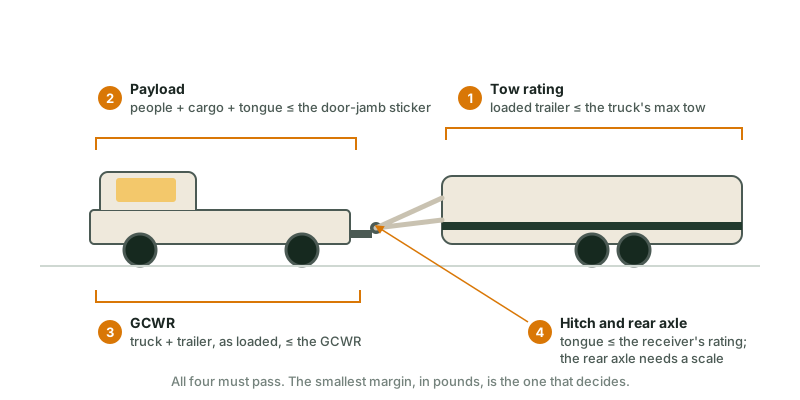
A trailer is towable when it passes four separate ratings, and the brochure's tow rating is usually the one with the most room. The same 8,495 lb GVWR travel trailer with a 720 lb sticker tongue, behind an example three-quarter-ton and an example half-ton, with two people, 100 lb of gear and a 100 lb weight-distribution hitch in each:
| Check | Load | Example ¾-ton (2,462 lb payload) | Example half-ton (1,300 lb payload) |
|---|---|---|---|
| Tow rating | 8,495 lb | 15,000 — 6,505 to spare | 11,000 — 2,505 to spare |
| Payload | 1,220 lb | 2,462 — 1,242 to spare | 1,300 — 80 to spare |
| Combined (GCWR) | 16,195 lb | 23,500 — 7,305 to spare | 17,000 — 2,805 to spare |
| Receiver | 720 lb | 2,000 — 1,280 to spare | 1,600 — 880 to spare |
Example trucks, invented for illustration; use your own stickers. Trailer planned at GVWR. ¾-ton: 15,000 lb tow, 23,500 GCWR, 7,200 curb, 2,000 lb WD receiver. Half-ton: 11,000 tow, 17,000 GCWR, 5,200 curb, 1,600 lb receiver. Cargo 500 lb = 2 × 150 + 100 + 100.
Both trucks pass the tow rating by thousands of pounds. The half-ton passes payload by 80 lb: one more adult and a full cooler and it's over, and nothing about the tow rating changed. The number people quote has room, and the number on the door jamb is the one that runs out. On the three-quarter-ton the tightest check is the payload at 1,242 lb to spare, which is what a well-matched pair looks like.
Why is the payload sticker the number that fails first?
It's the smallest of the four, and everything lands on it. Payload is GVWR minus the truck's curb weight as built, with the options, the bigger tires and the sunroof, printed on the driver's door-jamb placard as "the combined weight of occupants and cargo should never exceed". The brochure's payload is the best case for the lightest configuration; the sticker on your truck is the one that counts. The tongue weight is cargo, the people are cargo, the hitch itself is cargo. What a 13% tongue plus 500 lb of crew and hardware leaves on common stickers:
| Trailer GVWR | Tongue at 13% | Payload needed | 1,300 lb sticker | 1,800 lb sticker | 2,400 lb sticker | 3,200 lb sticker |
|---|---|---|---|---|---|---|
| 5,000 lb | 650 lb | 1,150 lb | 150 spare | 650 spare | 1,250 spare | 2,050 spare |
| 6,500 lb | 845 lb | 1,345 lb | over 45 | 455 spare | 1,055 spare | 1,855 spare |
| 8,000 lb | 1,040 lb | 1,540 lb | over 240 | 260 spare | 860 spare | 1,660 spare |
| 10,000 lb | 1,300 lb | 1,800 lb | over 500 | 0 spare | 600 spare | 1,400 spare |
| 12,000 lb | 1,560 lb | 2,060 lb | over 760 | over 260 | 340 spare | 1,140 spare |
Two seats at 150 lb, 100 lb of gear, a 100 lb WDH. Your sticker tongue weight replaces the 13% estimate when you enter it; a scale replaces both.
How much payload do I need?
Add up everything the truck carries that it didn't carry leaving the factory, and compare it with the door-jamb sticker. The regulation behind the sticker, 49 CFR 571.110, counts 68 kg (150 lb) per designated seat, so that's the figure the tool charges for each person; the rest is gear, the hitch itself, and the trailer's tongue or pin weight, usually the biggest line. Two budgets:
| Couple, 6,500 lb travel trailer | lb | Family of four, 12,000 lb fifth wheel | lb |
|---|---|---|---|
| 2 seats at 150 lb | 300 | 4 seats at 150 lb | 600 |
| Gear in the cab and bed | 100 | Gear in the cab and bed | 250 |
| Weight-distribution hitch | 100 | Fifth-wheel hitch in the bed | 200 |
| Tongue weight at 13% of 6,500 lb | 845 | Pin weight at 20% of 12,000 lb | 2,400 |
| Payload needed | 1,345 | Payload needed | 3,450 |
Trailers at GVWR (what they weigh the day it matters); tongue at 13% and pin at 20% until you've weighed them. Payload differs by trim, cab and options more than by model name, so use your own sticker.
The couple's 1,345 lb fits a half-ton whose sticker says at least that much, and plenty do; the family's 3,450 lb needs a sticker that says 3,450 or more, heavy-duty territory, and the pin is the line that puts it there. The tool above takes your own seats, gear and hitch, uses your sticker tongue or your scale ticket when you have one, and prints what's left or by how much it's over.
GVWR is the most a single vehicle, truck or trailer, may weigh loaded on its own wheels, and GAWR is the same for one axle; both are on the certification label that 49 CFR 567.4 requires. Payload is the truck's GVWR minus what it weighed leaving the factory, the room for people, cargo and the tongue, and it differs by trim, cab and options. GCWR is the most the truck and trailer may weigh together. The tow rating is GCWR minus a lightly loaded truck: curb weight with the required towing equipment, plus a 150 lb driver and a 150 lb front passenger. That's the SAE J2807 basis, and Ford and Chevrolet both print it in their towing guides. Every passenger after the second, every pound in the bed and the hitch itself comes off it, which is why it's the loosest of the four; the GCWR row in the tool charges them. CCC is the trailer's version of payload: GVWR minus its dry weight, printed on the yellow label, and it's what water, batteries and gear have to fit inside (the loaded-weight calculator adds them up). Every one of the five is a ceiling to stay under.
How do you estimate tongue weight and pin weight?
Until you've weighed it, plan it as a fraction of the loaded trailer. A travel trailer tows straight with 10%–15% of its weight on the tongue, the band Chevrolet's guide gives, and the tool plans at 13%, near the middle. A fifth wheel carries 15%–25% on the pin, planned at 20%, and that pin weight sits in the bed, which is why a fifth wheel's payload check is the one that fails and its tow rating almost never does. The dry hitch weight on the trailer's sticker is a floor for the loaded number, since batteries and propane sit on the tongue. Below 10% the trailer sways; above 15% the truck squats and the steering goes light. The tongue-weight calculator measures yours with a bathroom scale and a board.
What's the biggest trailer my truck can tow?
The lowest of three ceilings sets it: the tow rating; the payload left after the crew and the hitch, divided by the tongue fraction; and GCWR minus the loaded truck. With two people, 100 lb of gear and a WDH aboard the example three-quarter-ton above, by sticker:
| Payload sticker | By payload (travel trailer) | By GCWR | By tow rating | Max travel trailer | Max fifth wheel |
|---|---|---|---|---|---|
| 1,300 lb | 6,154 lb | 15,800 lb | 15,000 lb | 6,154 (payload) | 3,500 (payload) |
| 1,800 lb | 10,000 lb | 15,800 lb | 15,000 lb | 10,000 (payload) | 6,000 (payload) |
| 2,400 lb | 14,615 lb | 15,800 lb | 15,000 lb | 14,615 (payload) | 9,000 (payload) |
| 3,200 lb | 20,769 lb | 15,800 lb | 15,000 lb | 15,000 (tow-rating) | 13,000 (payload) |
The example ¾-ton's other ratings (15,000 tow, 23,500 GCWR, 7,200 curb). Travel trailer at 13% tongue with a 100 lb WDH; fifth wheel at 20% pin with a 200 lb hitch in the bed. Trailer weights are loaded weights, at GVWR.
Read the middle rows: the same truck with the same engine tows 6,154 lb on a 1,300 lb sticker and 14,615 lb on a 2,400 lb one. Each pound of payload is worth 7.7 lb of travel trailer, so a trim that gives up 1,000 lb of payload to a crew cab, a sunroof and 35-inch tires gives up about 7,692 lb of trailer. When you're choosing between trucks, compare the door stickers before the advertised tow ratings.
Can my motorhome tow this car?
Two checks decide it, both against the coach's own ratings: the toad's weight as towed against the coach's hitch rating, and the coach at its GVWR (or its weighed weight) plus the toad against the coach's GCWR. Hitch ratings vary widely by chassis, and the number is on the coach's hitch and in its manual. The second check is the one that surprises people: a coach loaded to its GVWR often has less GCWR room than its hitch rating suggests. A 4,200 lb SUV behind a 5,000 lb hitch passes by 800; the same SUV behind a coach with 4,000 lb of GCWR room fails by 200, and the fix is weighing the coach, which seldom sits at GVWR. Brakes are a separate question: a 3,500 lb car is over the published trailer-brake threshold in 40 of the 51 codes on the brake-controller page, so a toad usually needs a supplemental braking system whatever the weights say.
Can my truck carry this truck camper?
A truck camper is a payload question and nothing else: the camper's wet weight (the sticker inside the door, with water and propane) plus the people, the gear and the tie-downs, against the door-jamb payload. There is no tongue fraction; all of it rides on the truck, and most of it behind the rear axle. A 3,200 lb hard-side camper with two people, 200 lb of gear and 50 lb of tie-downs needs 3,750 lb of payload, a one-ton with the right options. Against the example three-quarter-ton's 2,462 lb sticker it's 1,288 lb over, and the tool prints that figure for your own truck before the camper is on it.
Everything above uses ratings and stickers. The one limit that needs a scale is the rear GAWR: a tongue weight sitting a few feet behind the rear axle levers weight off the front axle and onto the rear at more than one to one, so a truck under its payload can still be over its rear axle rating. A weight-distribution hitch exists to move that weight back forward; it changes how the load is shared between axles, and the combination weighs the same. The CAT Scale Ticket tool takes the three weigh-ins, fills in the axle loads and saves them to My Rig; until you've been across a scale, treat a passing payload check with a heavy tongue as "probably" and weigh before the long trip.
What if it fails?
Take pounds out of the truck first, then off the tongue. Over payload by 200 lb is one passenger riding in a second car, the generator moved from the bed to the trailer's rear rack, or a lighter hitch. Over payload by 800 is a different trailer or a different truck. Over the tow rating or GCWR is a different truck, full stop, and the tool says "not safe to tow" rather than rounding it. A weight-distribution hitch is the right fix for a saggy rear end and a light front axle, and it changes none of the numbers on this page. If a check passes by less than a couple of hundred pounds, weigh the whole combination loaded, because the trailer in your driveway weighs more than the brochure's dry figure.
Sources
- 49 CFR 571.110, Standard No. 110: Tire selection and rims and motor home/recreation vehicle trailer load carrying capacity information, eCFR, National Archives: S2 scope (10,000 lb GVWR or less); S4.3 door placard; S4.3.5 and S9.3.2: full propane in the UVW, water counted as cargo, weights as delivered to the dealer; S9.3.4–S9.3.5 label wording
- 49 CFR 567.4, Requirements for manufacturers of motor vehicles, eCFR, National Archives: the certification label that carries GVWR and GAWR
- 2024 RV & Trailer Towing Guide, Ford Motor Company: ratings "calculated with SAE J2807 method" with "a 150-lb. driver and passenger"; "Ford recommends 50% front axle load restoration"; no electric-brake trailer without a controller
- 2025 Chevrolet Trailering Guide, Chevrolet (General Motors): p. 7: maximum trailer weight rating = GCWR minus curb weight "plus 150 lbs. each for the driver and a front passenger"