Do I need a weight distribution hitch?
Look at the sticker on your receiver before you look at anything else. It carries two tongue-weight ratings, weight carrying (the ball alone) and weight distributing (with bars), and if your tongue is over the carrying figure, a WDH is not a comfort item: it is the only way the receiver is rated for the load. Behind that hard rule sit the makers' trailer-weight rules. Ford's towing guide says not to exceed a 5,000 lb trailer on an F-150 without a weight-distribution system, which at the 10% tongue load its tables assume is a 500 lb tongue, the figure the tool uses when it doesn't know your receiver. GM's Silverado 1500 manual makes one required over 7,000 lb. The general guidance adds any trailer at half the truck's weight or more, and Iowa writes a version into law: its Code § 321.430 requires a weight-equalizing hitch with sway control on any trailer of 3,000 lb or more. The tool runs the receiver, the maker's limit and the half-the-truck ratio in that order; here is the same half-ton (5,200 lb curb, 500 / 1,600 lb receiver) across the trailers people ask about:
| Trailer GVWR | Tongue at 13% | Of the truck | Verdict, receiver known | Receiver unknown | Bars |
|---|---|---|---|---|---|
| 2,500 lb | 325 lb | 48% | Optional | Optional | 400 lb step |
| 3,500 lb | 455 lb | 67% | Recommended | Recommended | 600 lb step |
| 5,000 lb | 650 lb | 96% | Required — 150 lb over WC | Recommended | 800 lb step |
| 6,500 lb | 845 lb | 125% | Required — 345 lb over WC | Recommended | 1,000 lb step |
| 8,495 lb | 1,104 lb | 163% | Required — 604 lb over WC | Recommended | 1,200 lb step |
| 10,000 lb | 1,300 lb | 192% | Required — 800 lb over WC | Recommended | 1,400 lb step |
Trailer planned at GVWR, tongue estimated at 13%. "Required" = the tongue exceeds the receiver's weight-carrying rating; "recommended" = over the 5,000 lb / 500 lb thresholds or ≥ 50% of the truck; "optional" = under all of them. Nothing here raises the truck's ratings.
A fifth wheel is not on the table because it is not a WDH question: the pin sits over the truck's rear axle and there is no lever to fix. Some unibody SUVs and vans forbid a WDH outright, and their manuals say so. Everything else with a ball on a bumper is answered by the tests above.
What size weight distribution hitch do I need?
Bars are sized by tongue weight. A 10,000 lb trailer with a 1,000 lb tongue and a 10,000 lb trailer with a 1,300 lb tongue take different bars, and the trailer-weight figure on the box is a ceiling for the trailer while the tongue figure does the sizing. The rule from the people who sell them is to land the tongue in the middle of the bars' range. Bars rated well above the tongue don't flex enough to transfer load, ride like a truck with no suspension, and hammer the trailer's A-frame; bars rated below it can't restore the front axle. The makers' sizes don't line up with each other, so the table uses this site's own steps and lists the bars each maker publishes beside the step they top out in:
| Step | Tongue range | Trailer at 13% tongue | Any trailer in the 10%–15% band | Makers' bars rated in this step |
|---|---|---|---|---|
| 400 lb | 200–400 lb | 1,538–3,077 lb | 1,333–4,000 lb | Blue Ox 350 · Equal-i-zer 400 |
| 600 lb | 400–600 lb | 3,077–4,615 lb | 2,667–6,000 lb | Blue Ox 550 · Equal-i-zer 600 |
| 800 lb | 600–800 lb | 4,615–6,154 lb | 4,000–8,000 lb | Blue Ox 750 · CURT 500–800 · Husky 800 |
| 1,000 lb | 800–1,000 lb | 6,154–7,692 lb | 5,333–10,000 lb | Blue Ox 1,000 · Equal-i-zer 1,000 · CURT 800–1,000 |
| 1,200 lb | 1,000–1,200 lb | 7,692–9,231 lb | 6,667–12,000 lb | Equal-i-zer 1,200 · Husky 1,200 |
| 1,400 lb | 1,200–1,400 lb | 9,231–10,769 lb | 8,000–14,000 lb | Equal-i-zer 1,400 · Husky 1,400 |
| 1,600 lb | 1,400–1,600 lb | 10,769–12,308 lb | 9,333–16,000 lb | Blue Ox 1,500 · Equal-i-zer 1,600 · CURT 1,000–1,500 |
| 2,000 lb | 1,600–2,000 lb | 12,308–15,385 lb | 10,667–20,000 lb | Blue Ox 2,000 |
The steps are the site's own sizing steps, and no maker sells this exact set: each runs from the step below to its top. Beside them, maximum tongue ratings as published by Equal-i-zer, Blue Ox (whose SwayPro manual sets a 200 lb minimum for the line, the floor of the first step), CURT (which prints a range per model: 500–800, 800–1,000 and 1,000–1,500) and Husky. The heaviest listed bar, 2,000 lb, closes the last step.
The 8,495 lb Imagine with its 720 lb sticker tongue lands 60% of the way up the 800 lb step, with nothing behind the truck's rear axle. That condition matters as much as the tongue does.
Why does cargo in the bed change the bars?
A weight-distribution hitch is a lever that pivots on the truck's rear axle. Everything behind that axle, the tongue and also the generator, the firewood, the cooler and the two bikes on the tailgate, is on the same side of the pivot, and the bars have to lever all of it forward. So the tongue weight the bars are sized by is the trailer's tongue plus the bed cargo behind the axle, and 200 lb of firewood moves the Imagine from the 800 lb step to the 1,000 lb step:
| Behind the rear axle | Effective tongue | Bars | Where in the step |
|---|---|---|---|
| nothing | 720 lb | 800 lb | 60% |
| 100 lb | 820 lb | 1,000 lb | 10% — the 800 lb bars would carry it and ride softer |
| 200 lb | 920 lb | 1,000 lb | 60% |
| 300 lb | 1,020 lb | 1,200 lb | 10% — the 1,000 lb bars would carry it and ride softer |
| 500 lb | 1,220 lb | 1,400 lb | 10% — the 1,200 lb bars would carry it and ride softer |
720 lb sticker tongue. The trailer's own load moves the tongue too (a full fresh tank forward of the axles, a generator in the pass-through), which is why a weighed tongue, loaded as you tow, beats the sticker; the tongue-weight calculator measures it with a bathroom scale.
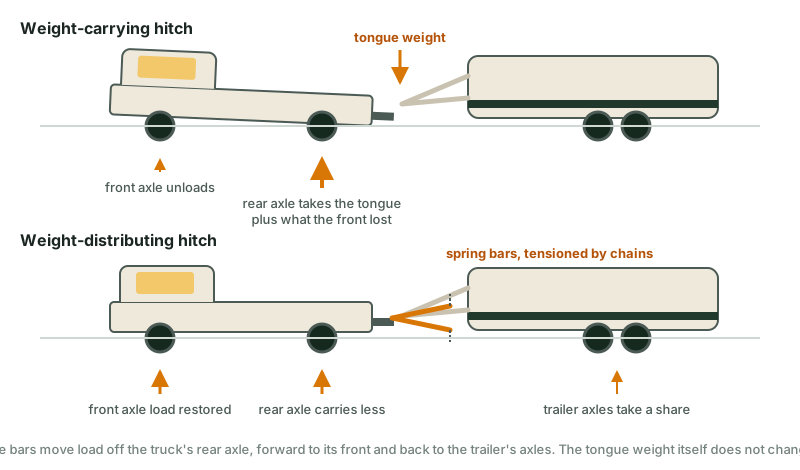
Hang 720 lb on a ball three feet behind the rear axle and the truck pivots: the rear squats and the front rises, taking weight off the axle that steers and does most of the braking. The bars' job is to put that weight back, and the truck makers say how much. Ford recommends 50% front axle load restoration; GM's manual and Ram's 2500/3500 manual both set the bars so the front fender comes back halfway, which is 50% too; Toyota's Tundra manual asks for the front axle back at its unhitched weight, 100%. Over 100% the bars are pushing the front axle past its unhitched weight, unloading the rear and stressing the trailer frame. A CAT scale measures this exactly (the scale-ticket calculator reads it off the ticket); a tape on the front fender is the driveway version below.
How do I know my weight distribution hitch is set up right?
Measure the front wheel-arch height three times on level ground: unhitched, hitched with the bars off, and hitched with the bars tensioned, the method GM's and Ram's manuals print. The front rises when you hitch, and the share of that rise the bars take back stands in for front-axle restoration. With a front that rose 1 in:
| Bars bring the front back down | Restored | Reading |
|---|---|---|
| 0.2 in | 20% | under — tighten a link / add a washer, or the bars are too light |
| 0.5 in | 50% | in the 50%–100% window |
| 0.8 in | 75% | in the 50%–100% window |
| 1 in | 100% | in the 50%–100% window |
| 1.3 in | 130% | over — back off a link; the rear is being unloaded |
Height is a proxy: suspension rate varies, so a front that came back ⅔ of the way has restored roughly ⅔ of the load. Confirm on a scale before a long trip; Ford's target is written in weight.
Buying a size up to "grow into" sounds safe. On a 720 lb tongue, 1,200 lb bars sit 280 lb below the bottom of their 1,000–1,200 lb step: at normal tension they barely deflect, so they transfer little and the front axle stays light; cranked until the front comes down, they push the whole load through the trailer's A-frame and coupler, the parts the spring in the bars was meant to spare. The tool flags bars you own that are too heavy for your tongue exactly as it flags ones that are too light, because both fail, in different ways.
Does a weight distribution hitch increase towing capacity?
It raises one rating, the receiver's tongue-weight limit, from its carrying figure to its distributing figure, and it puts weight back on the front axle. Ford's Super Duty tables say the rest outright: "trailer towing values are the same for weight-carrying and weight-distributing hitches." A WDH adds nothing to the truck's tow rating, payload or GCWR, and it costs about 100 lb of payload itself, because the head, shank and bars ride on the truck. A half-ton at its payload sticker with a 720 lb tongue is still at its sticker with the bars on; the towing-capacity calculator runs those four checks with the hardware charged. What a WDH changes is how the load sits, and with sway control built into the head (four-point friction, or a cam system) it also changes whether a high-sided trailer walks in a crosswind, which on a travel trailer over a few thousand pounds is the second reason to buy one. Sway control damps a swing and leaves its causes, a light tongue or a load that moved behind the axles, where they were; the sway guide sorts out which one you have.
Sources
- 2024 RV & Trailer Towing Guide, Ford Motor Company: ratings "calculated with SAE J2807 method" with "a 150-lb. driver and passenger"; "Ford recommends 50% front axle load restoration"; no electric-brake trailer without a controller
- 2024 Chevrolet Silverado 1500 Owner’s Manual, General Motors: weight-distributing hitch adjustment: front fender "halfway between the two measured ride heights"
- Iowa Code § 321.430, Brake, hitch, and control requirements, Iowa Legislature: 3: trailers and travel trailers at 3,000 lb gross or more: brakes from the cab or self-actuating, and a weight-equalizing hitch with sway control
- Weight Distribution Hitch / Sway Control, Equal-i-zer Hitch (Progress Mfg.): maximum tongue weights 400, 600, 1,000, 1,200, 1,400 and 1,600 lb; no minimum published
- SwayPro Owner’s Manual & Installation Instructions (405-0120), BXW0350–BXW2000, Blue Ox: 350, 550, 750, 1,000, 1,500 and 2,000 lb maximum tongue weight; "a minimum tongue weight of 200 lbs. is required"
- TruTrack 4P weight distribution hitch instructions, 17499, CURT Manufacturing: tongue weight 500–800 lb, gross trailer 5,000–8,000 lb
- TruTrack 4P weight distribution hitch instructions, 17500, CURT Manufacturing: tongue weight 800–1,000 lb, gross trailer 8,000–10,000 lb
- TruTrack 4P weight distribution hitch instructions, 17501, CURT Manufacturing: tongue weight 1,000–1,500 lb, gross trailer 10,000–15,000 lb
- Center Line TS Plus Weight Distribution Hitch, Husky Towing Products: tongue weight options 800, 1,200 and 1,400 lb; the site answers 403 to command-line checks but loads in a browser
- Recommended Distribution Hitch Adjustment, 2022 Ram 2500/3500 Owner’s Manual, Stellantis (Mopar): set the bars so the fender sits at (H2 − H1)/2 + H1, half the rise
- 2022 Toyota Tundra Owner’s Manual, trailer towing, Toyota Motor Sales USA: adjust the bars to return the front axle to its unhitched weight; toyota.com refuses automated fetches (403), so this is from the manual as read by our researchers