How do you measure tongue weight with a bathroom scale?
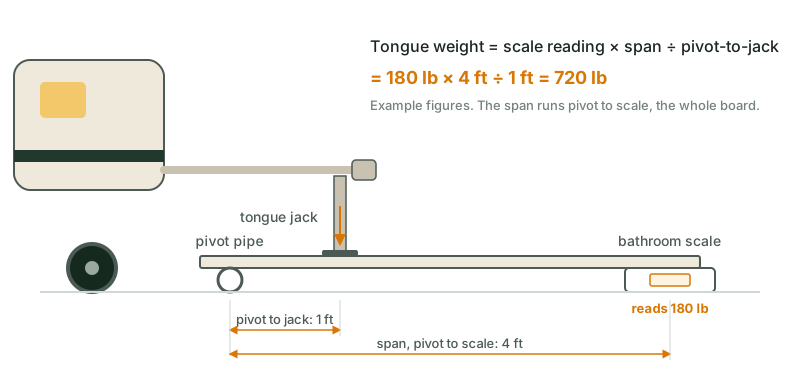
With a lever, because a loaded travel trailer's tongue is 600 to 1,000 lb and a bathroom scale stops at about 300. Park level, unhitch, and set the coupler at the height it rides at behind the truck, with the trailer loaded the way you tow; Blue Ox's SwayPro manual asks for exactly that before any tongue reading, because the figure changes with the nose angle. Lay a pipe on the ground as the pivot, the scale a few feet away with a block on it to spread the load, and a straight 2×4 across both. Zero the scale with the board on it. Lower the jack onto the board between the pipe and the scale, measure the two distances from the pipe, and read the scale. Tongue weight is the reading times the span over the jack distance: with the scale 4 ft from the pipe and the jack 1 ft from it, a reading of 200 lb is 800 lb.
The setups that keep a loaded tongue under the scale's limit, and how much each one forgives a sloppy tape measure:
| Pivot → scale | Pivot → jack | Ratio | 600 lb reads | 800 lb reads | 1,000 lb reads | 1 inch of jack error |
|---|---|---|---|---|---|---|
| 3 ft | 1 ft | 3:1 | 200 lb | 267 lb | 333 lb | 8.3% |
| 4 ft | 1 ft | 4:1 | 150 lb | 200 lb | 250 lb | 8.3% |
| 5 ft | 1 ft | 5:1 | 120 lb | 160 lb | 200 lb | 8.3% |
| 4 ft | 2 ft | 2:1 | 300 lb | 400 lb | 500 lb | 4.2% |
| 6 ft | 2 ft | 3:1 | 200 lb | 267 lb | 333 lb | 4.2% |
| 8 ft | 2 ft | 4:1 | 150 lb | 200 lb | 250 lb | 4.2% |
Red readings exceed a 300 lb scale. The last column is how much the answer moves if the jack sits an inch from where you measured; a 2 ft jack distance halves it, so a longer board is a better board.
Which lever ratio is right, 3:1 or 4:1?
Take moments about the pipe. The scale pushes up at the far end of the board, the jack pushes down at the jack distance, and for the board to sit still the two moments match: reading × span = tongue × jack distance. The multiplier is therefore the whole span over the jack distance, 4:1 for a jack 1 ft from the pipe and a scale 4 ft from it. Dividing the 3 ft from jack to scale by the 1 ft jack distance gives 3:1, an easy slip that reads every tongue a quarter light, and the tool prints that figure beside the right one so the gap is visible:
| Scale reads | Right: × 4 | Wrong: × 3 | Error |
|---|---|---|---|
| 150 lb | 600 lb | 450 lb | -25% |
| 200 lb | 800 lb | 600 lb | -25% |
| 250 lb | 1,000 lb | 750 lb | -25% |
Jack 1 ft from the pivot, scale 4 ft from it. The error is always low by the jack distance over the span, so it flatters a light tongue.
The direction of the error matters. The 3:1 figure makes a legal tongue look light, and a reader who trusts it moves weight forward to "fix" it and ends up over 15%, with the truck squatting and the steering light. A quick check on any setup: put a known weight on the board where the jack goes (yourself, say) and see whether the ratio gives that weight back.
A trailer is a beam balanced on its axles, and tipping it changes how much of it hangs on the tongue: jack the nose up and weight shifts back toward the axles, drop it and the reverse. Measure with the coupler at the height of the ball on your hitched, loaded truck (a tape from the ground to the top of the ball is enough) and with the trailer loaded the way it tows: water where it rides, propane on, bikes on the rack. The sticker's dry hitch weight was taken empty and level at the factory, so treat it as a floor for the number you'll measure.
What happens when tongue weight is too light or too heavy?
The band to stay in is 10% to 15% of the loaded trailer, the range the Chevrolet Trailering Guide gives for a conventional trailer (and 15%–25% for a fifth wheel's pin). Below it the risk is sway: too little of the trailer's weight sits ahead of the axles, a gust or a passing truck starts it oscillating, and at highway speed the swing can grow instead of dying out. That is the failure that puts trailers on their sides. Above it the truck squats, the front axle unloads so it steers and brakes badly, the headlights aim at the trees, and a receiver or payload rating can be exceeded; it's hard on the truck, but it isn't the one that rolls. That asymmetry is why the band's low edge is the one to respect, and why a little heavy is the safer error. If you're chasing a sway, when it happens tells you whether the tongue is the cause. The tool names the band for the loaded weight you enter, and the towing-capacity calculator runs the payload and receiver checks against the same number.
How do you adjust tongue weight?
You adjust it by moving cargo along the trailer. A trailer pivots on its axle group, so a load moved toward the coupler adds tongue weight in proportion to how far it moved over the coupler-to-axle distance: 100 lb moved 4 ft forward on a trailer whose axles sit 21 ft behind the coupler adds 19 lb of tongue. What 100 lb does by distance moved and trailer size:
| 100 lb moved forward | Axles 16 ft back | Axles 21 ft back | Axles 26 ft back |
|---|---|---|---|
| 2 ft | +13 lb | +10 lb | +8 lb |
| 4 ft | +25 lb | +19 lb | +15 lb |
| 6 ft | +38 lb | +29 lb | +23 lb |
| 8 ft | +50 lb | +38 lb | +31 lb |
Tongue change = cargo × distance moved ÷ coupler-to-axle distance. Rearward moves subtract the same amount. Axles about 70% of the way back on most tandem trailers.
Water and the rear bumper move the number the most. A full 52 gal tank is 434 lb; centered 5 ft ahead of axles 21 ft behind the coupler, filling it adds about 103 lb of tongue and draining it for the drive removes the same, which is why a trailer that tows straight from the campground can sway on the way home. Where your tank sits depends on the floor plan; the loaded-weight calculator uses this same position for its worked tank. Eighty pounds of bikes on a bumper rack 9 ft behind the axles of a 30 ft trailer takes 34 lb off the tongue and adds 80 lb to the trailer, so the percentage falls on both counts. To lift an 8,000 lb trailer from 8% to 12% you need 6,400 lb·ft of cargo moved forward on a 20 ft axle distance, 400 lb moved 16 ft, which is the whole pass-through storage. A trailer that measures light is usually fixed with the water tank or a different floor plan, seldom with the cooler.
Cargo behind the axles works on the tongue percentage twice: it takes load off the tongue and adds to the trailer weight the percentage is taken of. 80 lb of bikes on the bumper of a 30 ft trailer (9 ft behind the axles, which sit 21 ft behind the coupler) removes 34 lb of tongue. Two bikes, a generator and a couple of jerry cans, 250 lb on the bumper, take an 8,000 lb trailer's 12% tongue to 10.3% without anything else changing. Rear cargo is why the tool asks you to measure loaded, and why it accepts a negative move.
Bathroom scale, tongue scale or CAT scale: which one?
The lever costs nothing, and its accuracy is set by how well you measure the jack distance: an inch of error is 8.3% of the answer with the jack 1 ft from the pipe and 4.2% at 2 ft, so a jack 2 ft out, measured to the half inch, keeps the error near 2.1%. A purpose-made tongue scale (Sherline, or the gauge built into a Weigh Safe ball mount) reads directly and is worth it if you check every trip; the ball-mount gauges read while hitched, so nothing has been unhitched or re-leveled. The CAT scale is the reference: it weighs the whole truck with and without the trailer, needs no lever, and gives the axle loads at the same time, but it's a drive, and you can't repeat it in the driveway after you move the generator. Use the lever to adjust and the scale to confirm. Ford's towing guide computes its maximum trailer weights at a 10% tongue load, so a measured figure above that is already eating into the payload those tables assumed. Whichever method you use, the measured number is the one to size a weight-distribution hitch by.
Can you measure fifth-wheel pin weight with a bathroom scale?
A bathroom scale can't do it safely. A pin runs 15%–25% of the trailer, 2,000 to 3,000 lb on a typical fifth wheel, and even an 8:1 lever puts 313 lb on a scale rated for 300, on a board that won't take it. The pin is a truck-scale measurement: truck alone, then hitched, both axles, the same three-pass routine the scale-ticket calculator reads. The percentage bands, the effect of moving cargo and the coupler-height rule all apply; the bathroom scale doesn't.
Sources
- SwayPro Owner’s Manual & Installation Instructions (405-0120), BXW0350–BXW2000, Blue Ox: 350, 550, 750, 1,000, 1,500 and 2,000 lb maximum tongue weight; "a minimum tongue weight of 200 lbs. is required"
- 2025 Chevrolet Trailering Guide, Chevrolet (General Motors): p. 7: maximum trailer weight rating = GCWR minus curb weight "plus 150 lbs. each for the driver and a front passenger"
- 2024 RV & Trailer Towing Guide, Ford Motor Company: ratings "calculated with SAE J2807 method" with "a 150-lb. driver and passenger"; "Ford recommends 50% front axle load restoration"; no electric-brake trailer without a controller