How do you weigh a travel trailer at a CAT scale?
Make three passes with the same load every time, the middle one with the spring bars unhooked. Pull the whole rig on so the truck's front axle is on platform 1, its rear axle on platform 2 and the trailer axles on platform 3 (the attendant will tell you if you're straddling a seam), with the weight-distribution bars released, and take the ticket. Pull off, hook the bars up as you tow, and go around again as a reweigh. Then drop the trailer in the lot and weigh the truck alone, still with the people, fuel, dogs and gear aboard. The order doesn't matter; the consistency does, because a passenger who gets out between passes shows up as a 150 lb error in the tongue weight.
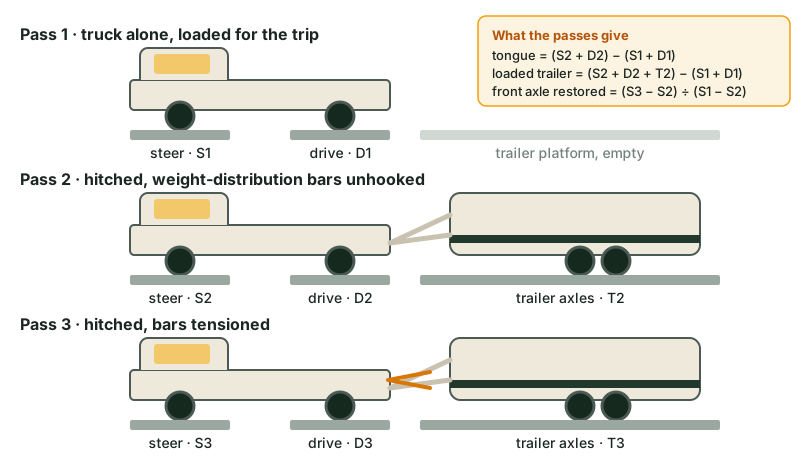
The worked ticket this page uses everywhere:
| Pass | Steer | Drive | Trailer | Gross |
|---|---|---|---|---|
| Pass 1: truck alone (bars off the truck) | 3,420 | 3,160 | — | 6,580 |
| Pass 2: hitched, bars released (the tongue-weight pass) | 3,180 | 4,240 | 5,960 | 13,380 |
| Pass 3: hitched, bars engaged (how you tow) | 3,340 | 3,900 | 6,140 | 13,380 |
Pounds, from a three-platform scale. The gross is the same on passes 2 and 3 because the bars only move weight between axles, a useful sanity check on your own ticket.
How do you read a CAT scale ticket?
The ticket prints one weight per platform plus the total, with the weigh number and the time. The steer figure is your front axle, the drive figure your rear axle (both rear axles together on a dually or a tag-axle coach), and the trailer figure is every trailer axle together. Nothing on it describes the hitch: the tongue weight is inside the steer and drive figures, spread across both, which is why the tool wants the truck-alone pass. A scale also weighs axles, not sides, so a trailer loaded heavy on the door side can be under its axle rating and over on one tire, and no ticket will show it.
How do you get tongue weight from a CAT scale?
Subtract the truck alone from the truck hitched, using both axles. On the ticket above the truck weighs 6,580 lb alone and 7,420 lb with the trailer on the ball, so the tongue is 840 lb, and the loaded trailer is the 5,960 lb on platform 3 plus that tongue: 6,800 lb, with 12.4% on the tongue, inside the 10%–15% band. The rear-axle shortcut, rear axle hitched minus rear axle alone, gives 1,080 lb, 240 lb too high, because the 240 lb the hitch lifted off the front axle landed on the rear one too. That's a 29% error on the number that sizes your hitch and decides your payload, and it always errs toward "you're overloaded". The bathroom-scale lever on the tongue-weight calculator gets the same figure without the drive, and it's the one to use while you adjust the load.
The ball sits a few feet behind the rear axle. Hang 840 lb there and the truck pivots on its rear axle like a seesaw: the rear axle picks up the tongue weight plus whatever the front axle gives up, and on this ticket the front gave up 240 lb. That's why the rear-axle shortcut overstates tongue weight, why an unloaded front axle makes the steering light and points the headlights at the trees, and why weight-distribution bars exist: they twist the trailer's frame against the truck's to lever weight back onto the front axle (and some onto the trailer's axles). The tongue weight stays the same; where it's carried changes, and the third pass measures exactly that.
What does the weight-distribution pass tell you?
It shows whether the bars are set right. Truck makers write the setup as Front Axle Load Restoration, the share of the front-axle weight the hitch removed that the bars put back. Ford "recommends 50% front axle load restoration" in its 2024 towing guide; GM's Silverado manual and Ram's 2500/3500 manual say the same thing in fender heights, setting the bars so the front comes back half the way it rose; Toyota's Tundra manual asks for all of it, the front axle back at its unhitched weight. So the window runs from 50% to 100%. On this ticket the hitch took 240 lb off the steer axle and the bars restored 160, 67%, in range. They also moved 180 lb onto the trailer's axles and took the drive axle from 4,240 to 3,900 lb, which is why the axle checks use pass 3 when you have one:
| Check | Rating | Bars released | Bars engaged |
|---|---|---|---|
| Steer axle | 3,450 lb | 3,180 — 270 spare | 3,340 — 110 spare |
| Drive axle | 4,050 lb | 4,240 — over 190 | 3,900 — 150 spare |
| Truck GVWR | 7,850 lb | 7,420 — 430 spare | 7,240 — 610 spare |
| Trailer GVWR | 7,500 lb | 6,800 — 700 spare | 6,800 — 700 spare |
| Trailer axles | 7,000 lb | 5,960 — 1,040 spare | 6,140 — 860 spare |
| Combined (GCWR) | 17,000 lb | 13,380 — 3,620 spare | 13,380 — 3,620 spare |
Example truck, for illustration: 3,450 / 4,050 lb GAWRs, 7,850 GVWR, 17,000 GCWR. Trailer: 7,500 GVWR, two 3,500 lb axles. The trailer's own total doesn't change with the bars.
Read the drive-axle row: bars released, the rear axle is over its rating by 190 lb; bars engaged, it's under by 150. Same truck, same trailer, same tongue weight, and the hitch adjustment is the difference between an overloaded axle and a legal one. Under-tensioned bars (FALR well under 50%) leave the rear axle loaded and the steering light; over-tensioned bars (above 100%) push the front axle past where it was solo and unload the rear, which hurts braking. The number tells you which way to turn the adjustment, and the weight-distribution calculator has the fender-tape version of the same check for a driveway with no scale.
Which number on the ticket goes against which rating?
Steer axle against the front GAWR and drive axle against the rear GAWR, both printed on the certification label in the driver's door jamb (the one 49 CFR 567.4 requires), and both judged as you tow, from pass 3 if you have one. Steer plus drive against the truck's GVWR. The trailer platform against the sum of the trailer's axle ratings, which its own label gives per axle, and the trailer total (axles plus tongue) against its GVWR. The gross against the truck's GCWR. That makes six checks, and the tool runs all six. The payload sticker isn't among them because it's the same test as GVWR (payload is GVWR minus curb), and the towing-capacity calculator already runs it from the ratings. What a scale adds to that page is a measurement: once you save this ticket, that page and My Rig stop planning at the trailer's GVWR and use what it weighed.
Rear axle hitched minus rear axle alone = tongue weight plus the weight the front axle gave up. On this ticket that's 840 + 240 = 1,080 lb, 29% high. The error makes a legal tongue look overweight, sends people shopping for a heavier-rated hitch they don't need, and hides the problem that is there, the light front axle. Use both axles, or a tongue scale.
What if the trailer weighs more than the brochure said?
The brochure's dry weight is the trailer as it left the line, before the dealer's battery, the options and everything you own. The gap between that number and the ticket is your cargo, and the trailer's GVWR is the ceiling for it; the loaded-weight calculator itemizes where those pounds came from. If the ticket puts the trailer within a couple hundred pounds of GVWR, water is the lever: 8.34 lb a gallon, 434 lb in a full 52 gallon tank. Where that weight lands depends on the floor plan. With the tank centered 5 ft ahead of the axles, the position the tongue-weight and loaded-weight calculators use, a full tank also puts 103 lb on the tongue, so traveling with a third and filling at the site lightens the trailer and the hitch together. If the truck's rear axle is the problem, move weight from the truck bed to the trailer's rear storage, where it takes load off the tongue, and re-check the bars. Then weigh again; the second ticket is cheap, and it's the one that goes in the glovebox.
Sources
- 2024 RV & Trailer Towing Guide, Ford Motor Company: ratings "calculated with SAE J2807 method" with "a 150-lb. driver and passenger"; "Ford recommends 50% front axle load restoration"; no electric-brake trailer without a controller
- 2024 Chevrolet Silverado 1500 Owner’s Manual, General Motors: weight-distributing hitch adjustment: front fender "halfway between the two measured ride heights"
- Recommended Distribution Hitch Adjustment, 2022 Ram 2500/3500 Owner’s Manual, Stellantis (Mopar): set the bars so the fender sits at (H2 − H1)/2 + H1, half the rise
- 2022 Toyota Tundra Owner’s Manual, trailer towing, Toyota Motor Sales USA: adjust the bars to return the front axle to its unhitched weight; toyota.com refuses automated fetches (403), so this is from the manual as read by our researchers
- 49 CFR 567.4, Requirements for manufacturers of motor vehicles, eCFR, National Archives: the certification label that carries GVWR and GAWR