How much RV antifreeze do I need?
A 30-foot trailer with one bathroom needs about 1.7 gallons, so buy 3: enough to fill everything that has to turn pink, plus a jug for the spills and the fixture you forgot. That's a volume, and it's small. The trailer has about 90 feet of half-inch PEX holding 0.83 gallons, four fixtures to purge on both sides, three P-traps, a toilet and a pump strainer. The familiar "2 to 4 gallons" advice lands close to that once a spare jug is added. Computed above for typical rigs, water heater bypassed:
| Rig | Length | Pipe | Antifreeze | Buy | After a blow-out | Heater not bypassed |
|---|---|---|---|---|---|---|
| Pop-up camper | 16 ft | 48 ft | 1.2 gal | 3 gal | 0.9 gal | 7.2 gal |
| Class B van | 21 ft | 63 ft | 1.5 gal | 3 gal | 1.0 gal | 7.5 gal |
| Travel trailer | 28 ft | 84 ft | 1.6 gal | 3 gal | 1.1 gal | 7.6 gal |
| Class C motorhome | 30 ft | 90 ft | 1.7 gal | 3 gal | 1.1 gal | 7.7 gal |
| Fifth wheel | 36 ft | 133 ft | 2.3 gal | 4 gal | 1.4 gal | 12.3 gal |
| Class A motorhome | 38 ft | 139 ft | 2.3 gal | 4 gal | 1.4 gal | 12.3 gal |
One bathroom (1½ for the fifth wheel and Class A), outdoor shower on all but the smallest, no washer or dishwasher, 6 gal heater (10 gal on the big rigs). "Buy" adds a spare jug.
Do I need to bypass the water heater?
The bypass valves send antifreeze around the water heater's tank instead of into it, and that one step changes the bill by a multiple. With the valves turned, the whole job on a 30-foot trailer is 1.7 gallons; without them the pump fills the 6-gallon tank first, 7.7 gallons in all. At an example $4.50 a jug that is about $27 of antifreeze poured into a tank that only needed draining, and a heater that tastes of glycol until June.
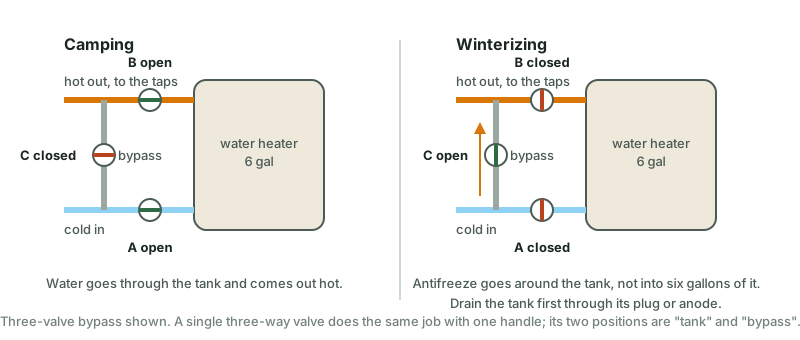
Many rigs have the three valves behind the heater (two on the lines, one crossover between them), and some have a single three-way valve that does the same job with one handle, and a bypass kit can be added to a rig that has neither. Drain the tank first, by pulling the plug or anode and opening the pressure-relief valve, and it stays empty and safe all winter. Its size is on the data plate behind the outside access door, and the water heater calculator saves it to your rig for every tool that needs it.
RV antifreeze is propylene glycol, food-safe in the concentrations that end up in a water line, and sold by its burst rating: Star brite's Winter Safe is rated to −50 °F and its premium jug to −100 °F. Automotive antifreeze is ethylene glycol and poisonous; it never goes in a potable system. Check the rating on the label, and don't dilute the pink with water left in the lines, since dilution is what weakens it; that's what the purge and the blow-out are for. Leftover jugs keep for years if sealed.
Blow out the lines, or use antifreeze, or both?
Both, if you own a compressor. Fit a blow-out plug on the city-water inlet and set 30 to 40 psi. That stays under the 40 to 50 psi an inline regulator such as Valterra's brass regulator holds city water to. The PEX tubing itself is rated far higher, 160 psi at room temperature under ASTM F876 according to PexUniverse's specifications, but the fittings, faucet valves and toilet valve publish no rating of their own, so the regulator's range is the sensible ceiling. Air clears most of the water from the lines, and the calculator credits a blow-out with leaving a quarter behind: the 30-foot trailer's job drops from 1.7 to 1.1 gallons. Air alone isn't enough, because it can't empty the P-traps, the toilet valve, the pump head or the low spots in a line that sags, and any of those can split in a hard freeze. Antifreeze alone works, costs a few dollars more and is the method dealers use. The one thing not to do is trust "drained": a system that's been drained still has cups of water in it, in the places that matter most.
What's the right order to winterize an RV?
The checklist above runs in four stages for your rig: drain, isolate, fill, protect. Drain first: fresh tank, both low-point drains, every faucet open, the water heater's plug out and its relief valve open. Isolate: turn the bypass, pull the water filter, close the drains again. Fill: the pump's winterizing siphon (or a hand pump at the inlet) pulls from the jug, and you work from the farthest faucet back, cold then hot, until each runs solid pink, with the toilet and the outdoor shower included. Protect: a cup down every drain for the traps, a little in the toilet bowl, a quart in each holding tank for the dump valves, then a note on the faucet so the heater doesn't get switched on in March with the tank empty.
What does antifreeze not protect?
The pump pushes antifreeze through the supply lines and nowhere else, so anything with its own pump or its own pocket of water needs its own step. Washers and dishwashers have their own pumps and need a rinse cycle with a gallon in the drum. Ice makers and fridge water lines are fed by a small valve that holds water on both sides: run it until pink, or shut the valve and blow the line. Tankless water heaters have no tank to bypass but a heat exchanger full of water; drain them per the manual (there are plugs and a screen) before running pink through. Batteries freeze when discharged, and a flooded battery freezes at a much higher temperature half-charged than full, so store them charged or keep a maintainer on. And the roof: every seam you didn't inspect in October is a leak you'll find in April.
At an example $4.50 a jug, the 30-foot trailer above costs $14 to winterize with the bypass turned (3 jugs) and $41 without it (9 jugs). The extra 6 jugs protect nothing, because a drained water heater tank was already safe.
Can I just pour antifreeze into the fresh tank?
Pouring it into the fresh tank is how people end up buying six gallons for a two-gallon job. The pump's pickup sits above the bottom of the tank, so the first gallon or two never reach the lines, and whatever is left has to be flushed out in spring and tastes of glycol for weeks. Many rigs have a winterizing valve on the pump with a short siphon hose: turn it, drop the hose in the jug, and the pump draws antifreeze straight from the container. On a rig without one, a hand pump screwed to the city-water inlet does the same thing from outside. Either way the jug empties into the lines and the tank stays clean, which is the reason the number above is small. Dealers charge for the same job, and doing it yourself takes the siphon hose or hand pump, the jugs, and the checklist for your rig.
When should you winterize?
Before the first night the forecast holds below 32 °F for more than a few hours in a row. A few degrees of frost overnight rarely freezes a line inside an insulated floor, but the outdoor shower, the low-point drains and an exposed pump don't get the benefit of the furnace, and a hard freeze with wind behind it can split fittings in a night. If you're still camping in it, keep the furnace on, the cabinets open and the tanks' heating pads powered, and winterize the day you park it for the season; the propane calculator works out how long the cylinders last at that temperature. Spring is the reverse of this list plus a sanitizing pass on the fresh tank with the bleach calculator, and the de-winterizing checklist is that list, generated for your rig.
Sources
- Valterra Brass Water Regulator 40-50 PSI, Camping World, Valterra specifications: inline RV regulators hold the supply at 40 to 50 psi
- PEX Tubing Technical Specifications and General Installation Recommendations, PexUniverse: PEX tubing (ASTM F876) rated 160 psi at room temperature, 100 psi at 180 °F
- Winter Safe -50°F Propylene Glycol Antifreeze, Star brite: burst protection to −50 °F
- -100°F Antifreeze for RV, Boat & Water System, Propylene Glycol, Star brite: burst protection to −100 °F