How long does propane last in an RV?
Anywhere from 1.7 days to about 29 on two 20 lb cylinders, and nearly all of that spread is the furnace. A gallon of propane holds about 91,500 BTU (the Propane Education & Research Council lists 91,502, the EIA 91,452). Cooking, hot water and an absorption fridge together burn a fraction of a gallon a day; a 30,000 BTU furnace burns a third of a gallon for every hour it fires, and how many hours that is depends on the temperature outside, not the calendar. Computed above for two 20 lb cylinders (9.4 gal), a 30,000 BTU furnace armed all day, two showers, an absorption fridge and 40 minutes of stove:
| Outside | Furnace duty | Furnace gal/day | Total gal/day | Two 20 lb last |
|---|---|---|---|---|
| 60 °F | 8% | 0.6 | 1.0 | 9.9 days |
| 50 °F | 18% | 1.4 | 1.7 | 5.4 days |
| 40 °F | 28% | 2.2 | 2.5 | 3.7 days |
| 30 °F | 38% | 3.0 | 3.3 | 2.8 days |
| 20 °F | 48% | 3.8 | 4.1 | 2.3 days |
| 10 °F | 58% | 4.6 | 4.9 | 1.9 days |
| 0 °F | 68% | 5.4 | 5.7 | 1.7 days |
Furnace holding 68 °F, duty cycle (68 − outside) ÷ 100; 6-gallon propane water heater at 12,000 BTU/h, 15 minutes of burner a shower; fridge burner 1,500 BTU/h, lit 50% of the day (our assumption; its thermostat decides); stove 9,000 BTU/h. A skirted rig or a smaller furnace does better; a drafty one worse.
That table is why one forum answer says "a week" and the next says "two days" about the same cylinders. At 50 °F the pair lasts about 5.4 days, at 30 °F 2.8, and at 10 °F 1.9. Both posters were right, about different weeks.
How much propane does an RV furnace use?
Input rating divided by 91,500 gives gallons per hour of burner time. What the common sizes cost when they fire, and what a freezing day costs once the duty cycle is applied:
| Furnace | Gal per hour firing | Hours per gallon | Gal/day at 30 °F, all day |
|---|---|---|---|
| 20,000 BTU | 0.22 | 4.6 | 2.0 |
| 30,000 BTU | 0.33 | 3.1 | 3.0 |
| 35,000 BTU | 0.38 | 2.6 | 3.5 |
| 40,000 BTU | 0.44 | 2.3 | 4.0 |
Input BTU (the number on the furnace label), not output. RV furnaces are 75 to 80% efficient, and the remainder goes out the exhaust either way; the heater sizing calculator works out how much of that output your rig needs.
The furnace also runs a 12 V blower at about 100 W the whole time it fires, which is the other half of the winter bill. The Power Budget counts it on the battery side using the same duty cycle. A propane furnace is a battery load; a catalytic or blue-flame heater is not, which is why so many winter boondockers carry one (the ventilation it needs is further down).
How much propane does an RV water heater, fridge and stove use?
Very little next to the furnace, which is the practical point: in summer a pair of 20 lb cylinders goes about 29 days. Suburban rates its 6-gallon SW6D at 12,000 BTU/h, and reheating the half tank a shower uses takes about 15 minutes of burner: 3,000 BTU, so two showers a day is 2.0 gallons a month. A tankless heater such as the Girard GSWH-2 burns 42,000 BTU/h, but only while water flows: an 8-minute shower is 5,600 BTU, about 1.9× the tank's figure, offset by burning nothing on standby. The water heater calculator works either one through for your inlet water.
An absorption fridge burns propane whenever its flame is lit; Dometic rates the DM2872 Americana II at 1,500 BTU/h on gas. The flame cycles on the thermostat, and assuming it burns about 50% of the day at mild temperatures, that is 18,000 BTU, 0.20 gal or 0.8 lb a day, 6 lb a week. In hot weather it burns longer. Atwood's three-burner ranges have one 9,000 BTU burner and two at 6,500; forty burner-minutes a day on the big one is a gallon every 15 days. An oven is a smaller burner than most people expect, 7,100 BTU/h on Furrion's 17-inch range. On a mild day the whole non-furnace list comes to 0.33 gallons, and the furnace at 50 °F adds 1.4 more, 4.3× everything else combined.
Why won't the furnace run when the cylinder still has propane?
A cylinder delivers vapor, and liquid propane boils off more slowly as it gets colder and emptier; PERC's pocket guide lists temperature and liquid level among the factors that set the rate. Motorsnorkel's cylinder vaporization table, for an upright cylinder a quarter full that has to keep 10 psi, puts a 20 lb cylinder at 18,450 BTU/h at 40 °F and 7,500 at 0 °F. A 30,000 BTU furnace asks for more than that on a mild night:
| Outside | 20 lb | 30 lb | 40 lb |
|---|---|---|---|
| 60 °F | 24,000 BTU/h | 32,000 BTU/h | 40,100 BTU/h |
| 40 °F | 18,450 BTU/h | 24,700 BTU/h | 31,000 BTU/h |
| 20 °F | 13,000 BTU/h | 17,300 BTU/h | 21,800 BTU/h |
| 0 °F | 7,500 BTU/h | 10,000 BTU/h | 12,600 BTU/h |
Motorsnorkel's figures: a vertical cylinder at 25% full holding a 10 psi minimum, under a steady draw, which the table calls conservative. A fuller, warmer cylinder does better, and a furnace that cycles recovers a little between burns. Compare with the furnace's input BTU.
Read that way, one quarter-full 20 lb cylinder can't feed a 30,000 BTU furnace at any temperature on the table (its best is 24,000 BTU/h at 60 °F), and two of them sharing the load keep up only down to about 30 °F. The symptoms are a furnace that short-cycles, a regulator that frosts, and a "half-full" cylinder that reads empty on the gauge. The fixes are bigger cylinders, both cylinders open through an auto-changeover regulator (it pulls from the reserve when the first one's pressure sags), keeping them out of the wind, and not letting them run low in deep cold. The calculator warns when your furnace's rating is above what your cylinder can deliver at the temperature you entered.
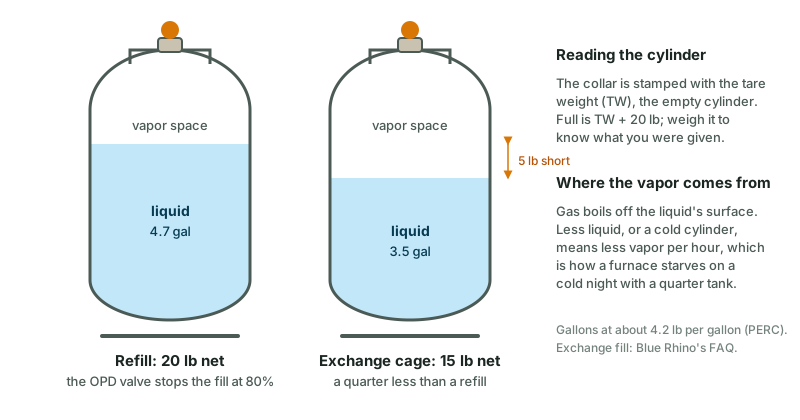
DOT cylinders are named by the pounds of propane they hold when properly filled: 20 lb is 4.7 gal (431,604 BTU), 30 lb is 7.1 gal, 40 lb is 9.4 gal, at about 4.2 lb a gallon. An exchange cylinder is filled to less: Blue Rhino puts 15 lb in its tanks, 3.5 gal, 25% less than a refill, and the FTC's 2014 settlement records Blue Rhino and AmeriGas cutting the fill from 17 lb to 15 in 2008. A motorhome's horizontal ASME tank is named by its water capacity and filled to 80% for expansion room, so a "20 gallon" tank carries 16 gallons of propane, which is how the days above count it. To see what's left in a cylinder, weigh it: the tare weight (TW) stamped on the collar is the empty weight, and every 4.2 lb or so above it is a gallon.
At an example $22, a 15 lb exchange cylinder (3.5 gal) works out to $6.22 a gallon. A refill at a propane dealer at $3.50 a gallon fills the same cylinder to its full 20 lb. On the freezing-day burn above (3.3 gal/day) that's $20.64 a day from the cage against $11.61 refilled, or $63 more for a week of winter camping. Prices vary by region; put yours in the price box.
How do you make RV propane last longer?
Work on the furnace's duty cycle, because little else moves the number. Dropping the thermostat from 68 to 63 °F at 30 °F outside takes the duty cycle from 38% to 33%, about 13% less propane, and a warmer blanket costs nothing. Skirting a parked trailer and closing the slide-out gaps do the same job from the other side, by raising the effective outside temperature the furnace sees.
Heating only the room you're in is the other lever. A catalytic or blue-flame heater is unvented: it burns the air in the rig and leaves its exhaust and water vapor inside, which is why every BTU counts as heat and why it needs no blower. It is also why Camco's Olympian Wave 3 instructions say the heater consumes air from the room and ask, in an RV, for a roof vent and a window cracked open at opposite ends. Run one with that fresh air and a working CO detector, and never while everyone is asleep with the rig shut tight. A 1,500 W electric heater on hookups burns no propane at all. On the small burners: switch the water heater to electric on a pedestal, turn it off between showers when boondocking, and put the fridge on AC whenever there's a cord.
How much does propane cost per day in an RV?
Gallons a day times what you pay a gallon, shown beside the days. With the example prices above: about $0.92 a day in summer with an electric water heater and the fridge on gas, $12 to $21 a day in freezing weather depending on where you fill, and more with a dual-fuel generator on propane. Champion rates its 2,500 W 201122 at up to 34 hours on a 20 lb cylinder at a quarter load, 0.14 gal an hour, and a heavier load burns faster; the generator runtime calculator works out the hours at your load. On hookups, switch the water heater to electric and the fridge to AC; off-grid in winter, a bigger cylinder pair is cheaper than a week of exchanges.
Sources
- The Propane Technical Pocket Guide, Propane Education & Research Council: 91,502 BTU per gallon, 21,548 BTU per pound, 4.2 lb per gallon at 60 °F; vaporization falls with temperature and liquid level
- British thermal units (Btu), U.S. Energy Information Administration: propane at 91,452 Btu per gallon
- How much propane does Blue Rhino put in its tanks?, Blue Rhino: exchange cylinders hold 15 lb of propane, net
- Blue Rhino, AmeriGas Settle FTC Charges of Restraining Competition, Federal Trade Commission: the 2008 cut in exchange fills from 17 lb to 15 lb
- Dometic DM2872 Americana II Absorption Refrigerator, 8 cu.ft., Camping World, Dometic specifications: power consumption on gas, 1,500 BTU/h
- Direct Spark Ignition Porcelain Lined, Steel Tank Water Heaters, 6 Gallon, Suburban: SW6D: 12,000 BTU/h, 10.1 gal/h recovery on gas; 1,440 W element, 6.1 gal/h
- Owner’s Manual, Model GSWH-2, Girard Products: 42,000 BTU/h; a minimum of 0.80 gpm per hot faucet
- Atwood & Wedgewood Vision 3-Burner Ranges, Atwood, via Camping World: one 9,000 BTU burner and two 6,500 BTU burners
- Furrion 17" RV 3-Burner All Glass Gas Range with FFD (FGR17G3MA2B-BG), Camping World, Furrion specifications: oven burner 7,100 BTU/h
- Propane Consumption Rate, Motorsnorkel by US Carburetion: vaporization of vertical 20, 30 and 40 lb cylinders at 25% full, 10 psi minimum, by outside temperature
- Camco Olympian Wave3 Installation Information, Camco, via ManualsLib: the heater consumes air from the room; in an RV, a roof vent and a window open at opposite ends
- 2500-Watt Dual Fuel Inverter, model 201122, Champion Power Equipment: up to 34 hours at 25% load on a 20 lb cylinder