How many watts is 30 amp RV service? And 50 amp?
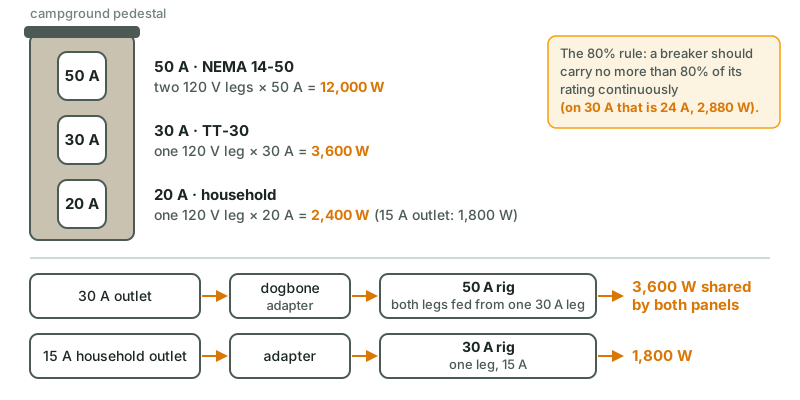
Watts are volts times amps, and every RV pedestal is 120 V per leg, so a 30 A service is 30 × 120 = 3,600 W. A 50 A service has two separate 120 V legs at 50 A each, 12,000 W in total. That is why the jump from 30 to 50 is more than three times the power, and why a 50 A rig can run two air conditioners while a 30 A rig can barely run one alongside the water heater. What each connection delivers, including the adapter cases:
| Connection | Watts to the rig | Per leg | Note |
|---|---|---|---|
| 30 A pedestal, 30 A rig | 3,600 W | 3,600 W × 1 | One 120 V leg |
| 50 A pedestal, 50 A rig | 12,000 W | 6,000 W × 2 | Two 120 V legs, 6,000 W each |
| 50 A rig on a 30 A pedestal through an adapter | 3,600 W | 3,600 W × 1 | Adapter bridges both rig legs to one 30 A leg |
| 30 A rig on a 15 A household outlet through an adapter | 1,800 W | 1,800 W × 1 | A household circuit and its own 15 A breaker |
| 50 A rig on a 15 A household outlet through an adapter | 1,800 W | 1,800 W × 1 | Same 1,800 W, now feeding a big rig |
Amps × 120 V. An adapter is limited by its smaller end; a 50-to-30 dogbone joins both of the rig's legs to the pedestal's one.
What can you run on 30 amp RV power at the same time?
One big thing and some small things. A 13,500 BTU air conditioner runs at about 1,500 W. Add the water heater's 1,440 W element (Suburban's figure for its 6-gallon tank; the water heater calculator weighs it against propane) and you're at 2,940 W, 82% of the service, with 660 W for everything else, including the converter that's quietly charging the batteries. The microwave doesn't fit on top. The order you switch things on matters as much as the total, because the AC's start surge lands on whatever is already running. The combinations people ask about, through the same check as the tool:
| Running together | Watts | On 30 A | On 50 A |
|---|---|---|---|
| AC only | 1,500 W | fine | fine |
| AC + electric water heater | 2,940 W | start the AC first; hot | fine |
| Soft-start AC + electric water heater | 2,940 W | fits, hot | fine |
| AC + water heater + microwave | 4,140 W | trips | fine |
| AC + water heater + space heater | 4,440 W | trips | fine |
| Two ACs, nothing else | 3,167 W | won’t start | fine |
13,500 BTU AC at 1,500 W running and 3,000 W starting, 15,000 BTU at 1,667 / 3,333 W; a soft start here takes the surge down to the running draw. "Fine": under the breaker and the 80% continuous rule, and the AC starts with everything on. "Fits, hot": under the breaker but over 80% (2,880 W on 30 A). "Start the AC first": everything runs, but the AC's surge on top of the rest doesn't fit, so switch it on before the rest. "Won't start": even switched on first, in the best order, a start is over the breaker. "Trips": the running total alone is over.
The last row surprises people. Two air conditioners on 30 A draw 3,167 W running, which looks as if it fits, and the pair never gets there: whichever unit starts second does so on top of the first one's running draw, and the best order still peaks at 4,667 W, 1,067 W over the breaker. Soft starts on both bring the peak down to 3,167 W, and the pair then runs over the 80% line with nothing else on. On a 30 A pedestal, plan on one air conditioner at a time.
A pedestal breaker is thermal-magnetic: a dead short trips the magnetic side at once, and an overload trips it by heating a bimetal strip. Heat adds up, so a breaker carrying close to its rating for hours, in a box that has sat in the sun all afternoon, can open below the number on its handle. The electrical code (NEC 210.19 and 210.20) sizes circuits so continuous loads, the ones that run three hours or more such as an air conditioner in July, a water heater element, a space heater or the converter, stay under 80% of the breaker. On 30 A that's 2,880 W of continuous load. Between 80% and 100% the check says "fits, hot", the zone where it worked last week and may not today.
Can you plug a 50 amp RV into 30 amp power?
Yes, with a 50-to-30 dogbone adapter, and the result is a 30 A rig for the duration: 3,600 W in total, fed to both legs of your panel from one pedestal leg. Nothing about the adapter makes more power. The 3,750 W printed on many of them is 30 A at the plug's 125 V rating, which describes the small end. What changes from a rig built for 30 A is that you have two ACs and a panel full of 120 V appliances wired as if 12,000 W were available, so the discipline is yours: one AC, the water heater on propane, and start the AC before the microwave. A 30 A rig on a 50 A pedestal is the easy direction. The adapter drops the rig onto one 50 A leg, and the rig's own 30 A main breaker is the limit.
Why does the AC trip the breaker when everything else fits?
The compressor asks for about twice its running draw in the first half-second it starts. 1,500 W running is 3,000 W starting for a bare 13,500 BTU unit, so the AC and water heater that fit at 2,940 W become 4,440 W the instant the thermostat calls, and the breaker sees it. Two fixes: start the AC first, with the water heater and microwave off, so the surge lands on an empty circuit; or fit a soft start, which removes about 70% of the inrush in this site's model (Micro-Air rates its EasyStart 364 at 65–75%) and makes the order stop mattering. The check above runs both the running total and the start total, and says which one you're failing. With two air conditioners on 30 A the order can't help, since the second one always starts on top of the first: that's the "won't start" row in the table.
What does the 50 amp "two legs" thing mean in practice?
Your 50 A panel splits its breakers between the two legs at the factory, usually with one AC on each. Each leg carries 6,000 W, so a 50 A rig can trip one leg while the other idles: the 15,000 BTU front AC, the water heater element, a hair dryer and the electric kettle on the same leg come to 6,107 W. The tool warns when the running total exceeds a single leg, because whether it trips depends on wiring you can only learn by opening the panel (or by watching an EMS that reads each leg). Rigs on a 50-to-30 adapter don't have this problem; they have the smaller one. On a generator the arithmetic is the same against its running watts, and the generator size calculator runs it with the altitude derate.
Every check on this page assumes the pedestal delivers 120 V. A busy park on a hot weekend sags under load, and a compressor on low voltage draws more current, runs hotter and dies younger. A miswired pedestal with an open neutral can push one leg of a 50 A rig far above 120 V, toward the 240 V between the two hot legs. An electrical management system is a surge protector that also disconnects on low voltage, high voltage, open ground and open neutral. Progressive Industries' portable units, for example, cut power when the line stays below 104 V or climbs above 132 V, and are rated 1,790 joules (EMS-PT30X) and 3,580 joules (EMS-PT50X), per the maker's manual. It's the one product this page recommends for every rig, sized by the inlet, and the result panel names the size you need.
Amps to watts, and back
Watts = amps × 120 on shore power; amps = watts ÷ 120. A 12 A appliance nameplate is 1,440 W; a 1,500 W space heater is 12.5 A. The amps-to-watts box under the tick-list does it for anything not on the list. The same load on the 12 V side is ten times the amps plus inverter losses, which is why the Power Budget keeps the two sides apart and the battery runtime calculator divides by 12.8 instead of 120. A 12 V run's own losses, the volts a thin cable burns before they reach the device, are the wire size calculator's job.
Sources
- Direct Spark Ignition Porcelain Lined, Steel Tank Water Heaters, 6 Gallon, Suburban: SW6D: 12,000 BTU/h, 10.1 gal/h recovery on gas; 1,440 W element, 6.1 gal/h
- Micro-Air Easy Start 364 w/ Bluetooth, Battle Born Batteries (retail listing of the Micro-Air soft starter): 65–75% start current reduction against the compressor’s locked-rotor amps
- Electrical Management System (EMS) EMS-PT30X & EMS-PT50X Instruction Manual, Progressive Industries: Surge ratings of 1,790 J (EMS-PT30X) and 3,580 J (EMS-PT50X); power cut below 104 V or above 132 V. The maker’s manual, as hosted on Amazon’s product-document server