Can you run an RV air conditioner on batteries?
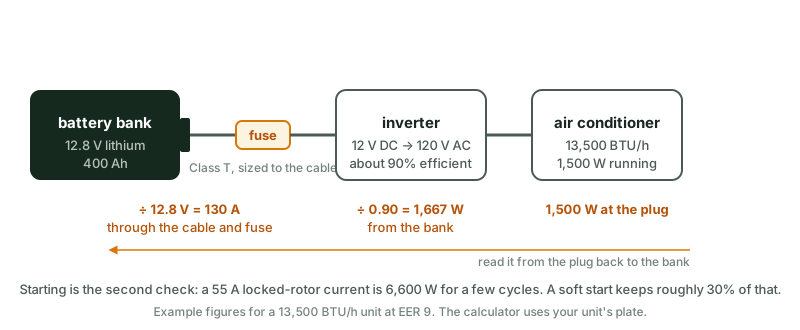
Yes, for some hours of a night, and only when three things line up: an inverter that can start the compressor, a bank whose BMS can supply the amps, and enough usable watt-hours for the hours you want. Most "it tripped" stories are the first two; most "it died at 2 am" stories are the third. A 13,500 BTU rooftop unit runs at about 1,500 W (EER 9) and surges to at least 3,000 W for a fraction of a second as the compressor starts (the data plate's LRA often says more). Through a 90% inverter that is 130 A from a 12 V bank running and 260 A at the start. Then the compressor cycles, and the duty cycle decides the hours more than the battery does:
| Lithium bank (100 Ah units) | Mild night · 40% | Warm · 60% | Hot · 80% |
|---|---|---|---|
| 200 Ah | 2.8 h | 1.9 h | 1.4 h |
| 300 Ah | 4.3 h | 2.9 h | 2.1 h |
| 400 Ah | 5.8 h | 3.9 h | 2.9 h |
| 600 Ah | 8.8 h | 5.8 h | 4.4 h |
| 800 Ah | 11.8 h | 7.9 h | 5.9 h |
13,500 BTU standard unit, 1,500 W running, from a full bank to the 20% floor, 90% inverter with 20 W idle, Peukert 1.03 on lithium, nothing else on. The "2 hours" and "6 hours" often quoted for 400 Ah are the 80% and 40% columns.
So a 400 Ah lithium bank gives about 3.9 h on a warm night, which is the arithmetic behind "400–800 Ah for a night": an 8-hour night at 60% needs 8,160 Wh from the bank, 8 × 100 Ah lithium from full, and that is with nothing else running and the fridge already counted elsewhere.
How many batteries does it take to run an RV AC overnight?
| Unit, 8 hours at 60% | Average draw | Wh for the night | 100 Ah lithium | 100 Ah AGM |
|---|---|---|---|---|
| 11,000 BTU standard | 835 W | 6,679 Wh | 7 | 12 |
| 13,500 BTU standard | 1,020 W | 8,160 Wh | 8 | 14 |
| 15,000 BTU standard | 1,131 W | 9,049 Wh | 9 | 16 |
| 13,500 BTU inverter-driven, throttled | 770 W | 6,160 Wh | 7 | 11 |
Average draw = running W × duty ÷ 0.9 + 20 W idle; batteries = Wh ÷ usable Wh per battery (1,024 Wh lithium at 80% DoD, 600 Wh AGM at 50%). The inverter-driven row is the same 13,500 BTU of cooling at EER 12, throttled to 60% output instead of cycling. For the whole day around it, fridge and furnace included, the battery-bank calculator sizes from your Power Budget.
The AGM column is why so few people try this on lead-acid: half the usable capacity, Peukert on top at these draws, and a bank that weighs 910 lb. The inverter-driven row changes the picture more than any battery does. A variable-speed compressor ramps up gradually, with no surge (Furrion's Chill Cube is sold on exactly that), and at EER 12, this site's planning figure, since the makers don't publish one, it runs on 1,125 W flat out and far less throttled. The same bank runs one about 1.3 times as long as a standard unit at the same cooling, with no start surge, which makes the unit type a bigger lever than a battery purchase.
A rooftop AC is either on or off; the thermostat runs the compressor until the coach hits the set point, then rests. The share of the hour it runs is the duty cycle, and it is set by heat gain (outside temperature, sun on the roof, how well the rig is insulated, what you set the thermostat to) more than by the AC. The same 13,500 BTU unit is a 600 W average load on a 72 °F night in the shade (40%) and a 1,500 W load at 3 pm in Arizona (100%). That spread is the whole difference between "400 Ah got me through the night" and "400 Ah lasted two hours," and both reports can be accurate. Pick the row that matches your night above, or watch how long the compressor rests on a night like the one you're planning.
What size inverter to run an RV air conditioner?
One that starts it. Running is easy: 1,500 W fits a 2,000 W inverter with room. The compressor's locked-rotor inrush is far more. The data plate under the shroud lists the LRA; at an example 55 A that's 6,600 W for a few cycles, and it has to fit under the inverter's surge rating with everything else that's on. A soft start (Micro-Air EasyStart, SoftStartRV) removes about 70% of that inrush in this site's model (Micro-Air rates its EasyStart 364 at 65–75% of the locked-rotor current), 1,980 W here, and that is what turns "runs it, won't start it" into "starts it" on every inverter below 4,000 W:
| Inverter (surge 2×) | Standard: start 6,600 W | With soft start: start 1,980 W |
|---|---|---|
| 1,500 W | needs a soft start | starts it |
| 2,000 W | needs a soft start | starts it |
| 3,000 W | needs a soft start | starts it |
| 4,000 W | starts it | starts it |
13,500 BTU, 1,500 W running, LRA 55 A from the plate. "Needs a soft start" = the running load fits but the inrush is over the inverter's surge rating and the soft-start figure is under it. Without an LRA the tool assumes a 2× surge, which is the optimistic case; enter the plate figure.
The calculator says which state you're in with your own inverter and, when a soft start would fix it, says so instead of pointing at a 3,000 W inverter. For everything else on the inverter, the inverter size calculator adds up the loads. A soft start is also the difference on a small generator, which is where most people meet it first.
Can the batteries supply the amps?
Every lithium battery has a BMS with a continuous discharge limit, 100 A on most 100 Ah units, and a short-term peak it tolerates for seconds. Battle Born's BB10012 data sheet, for one, gives 100 A continuous and 200 A for 30 seconds; the tool assumes 1.5× for the peak and says so, so check your own sheet. Batteries in parallel add theirs. The 13,500 BTU unit through a 90% inverter pulls 130 A running and 260 A at the start, so:
| 100 Ah lithium, 100 A each | Rated / peak | Running 130 A | Start 260 A |
|---|---|---|---|
| 1 × 100 Ah | 100 / 150 A | over, BMS opens | over, trips at start |
| 2 × 100 Ah | 200 / 300 A | fine | fine |
| 3 × 100 Ah | 300 / 450 A | fine | fine |
| 4 × 100 Ah | 400 / 600 A | fine | fine |
At 12.8 V and 90% inverter efficiency, nothing else on. Two batteries are the floor for a standard 13,500 BTU unit; one battery cannot even run it. A soft start also cuts the start amps, which is the second reason it's the first purchase.
Amps that size also set the cable. 130 A over a few feet of battery cable, with a fuse at the bank, is the wire size calculator's job; it rates the cable for the higher current the inverter pulls as the battery nears empty.
Can solar run an RV air conditioner?
A warm night at 60% takes 8,160 Wh out of the bank; a flat-mounted 600 W array makes about 1,890 Wh on an average day (4.5 peak-sun hours × 0.7), which is 23% of it. Solar won't put a night back, and it won't carry the AC through a summer day either. To recover the night in one day you'd need about 2,590 W of panels, more roof than a 40-foot fifth wheel has, and the array would be making that power at the same hours the AC wants it most. So the useful question is running the AC from solar at noon, which a 1,200 W array on a good day covers for a throttled inverter-driven unit and not for a cycling standard one.
| Array | Average day makes | Of a 60% night (8,160 Wh) |
|---|---|---|
| 400 W | 1,260 Wh | 15% |
| 800 W | 2,520 Wh | 31% |
| 1,200 W | 3,780 Wh | 46% |
Flat-mounted, 4.5 peak-sun hours (contiguous-US annual average) × 0.7; the solar page uses your state and season.
Adding a fifth 100 Ah battery to a 400 Ah bank buys about 60 min of warm-night cooling and 25 lb of cargo. Swapping the standard unit for an inverter-driven one keeps the same 13,500 BTU of cooling and cuts the average draw from 1,020 W to 770 W at the same 60% output; the same four batteries then run it for 5.1 h instead of 3.9 h, 1.3 h more, with no start surge for the inverter or the BMS to survive. A soft start is the cheaper half of the same idea: it adds no hours, and its job is getting the compressor started on the inverter you have.
What gets you through the night on batteries?
In order of what it costs: a soft start on the unit you have; the thermostat two degrees higher and the rig pre-cooled on shore power before you unplug; shade, a reflective roof and closed blinds, which move the duty cycle a column to the left; a bank sized from the tables above for the duty cycle you expect; and the inverter-driven unit when the rooftop one dies. The generator still handles the afternoon. Run it to pre-cool and to refill, and let the bank carry the quiet hours after generator curfew.
Sources
- Furrion Chill Cube 18K Variable Speed RV Rooftop Air Conditioner, Furrion: Variable-speed compressors that ramp up without a start surge; no published EER
- Micro-Air Easy Start 364 w/ Bluetooth, Battle Born Batteries (retail listing of the Micro-Air soft starter): 65–75% start current reduction against the compressor’s locked-rotor amps
- 100 Amp Hour 12 Volt LiFePO4 Deep Cycle Battery, Model BB10012 (data sheet), Battle Born Batteries: 50 A maximum charge (0.5C); absorption and cell balancing at 14.2–14.6 V; charge temperature 25–135 °F; 100 A continuous, 200 A for 30 s; 28 W heater on the BB10012H